What the pressure gauge is telling you
Combi and system boilers run on a sealed circuit. Unlike an older open-vented system fed by a tank in the loft, the water in a sealed system is held under pressure, and the boiler monitors that pressure constantly. If it falls too low, most boilers lock out and show a fault code rather than run with too little water.
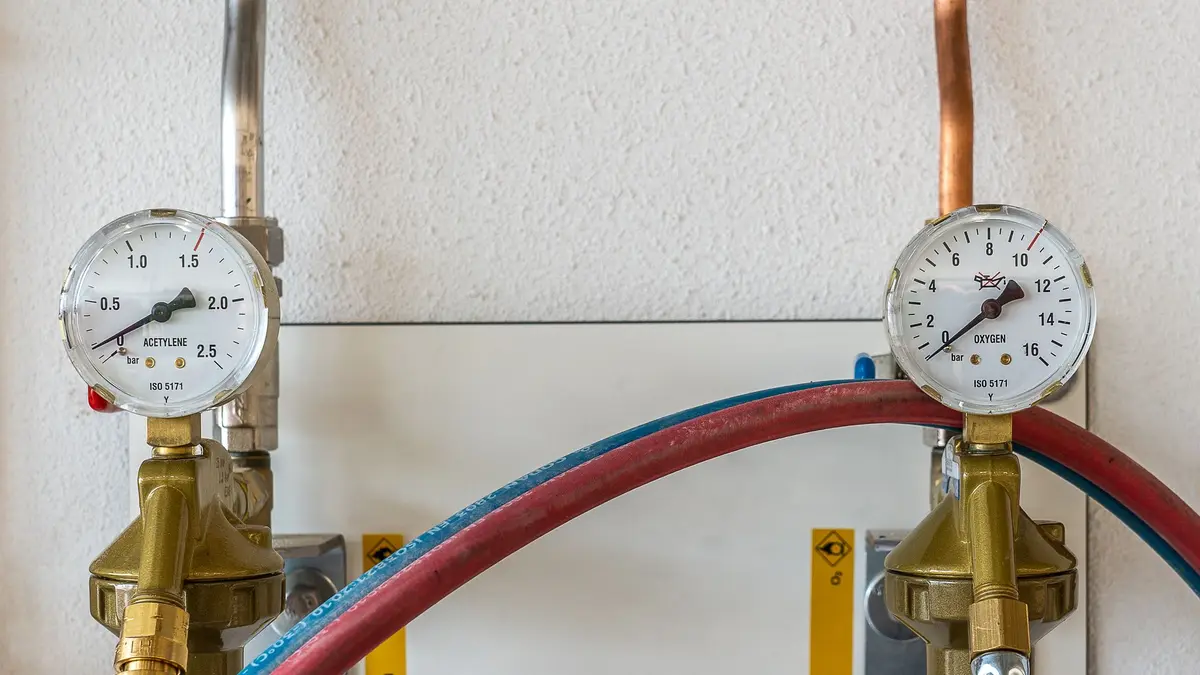
The gauge sits on the front panel, either as a dial with a needle or a digital readout. With the heating off and the system cold, most manufacturers ask for somewhere around 1 to 1.5 bar. Your manual gives the exact figure for your model, so check it before doing anything. When the heating runs, the reading rises a little as the water expands, and a climb of roughly half a bar is normal.
Before you touch anything, gather a few facts:
- Read the gauge when the system is cold. First thing in the morning is easiest.
- Write the figure down and check again the next day, so you know how fast it is falling.
- Note any fault code on the display, as it tells an engineer a lot.
- Look for a red zone on the dial. Below it, many boilers will refuse to fire.
Pressure that drops once, straight after you have bled the radiators for instance, is expected. Pressure that falls again and again is telling you water is leaving the system somewhere, and the rest of this guide is about finding out where.
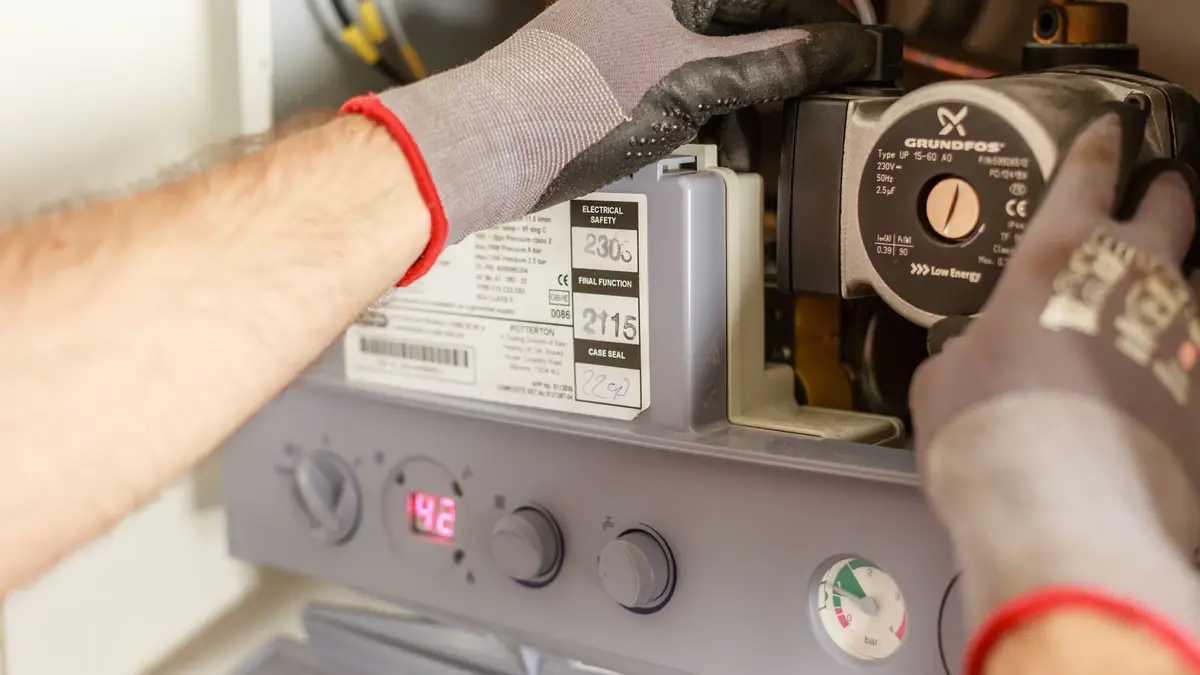
Topping up through the filling loop
Topping up is a job most householders can do, and your boiler manual will show the filling arrangement for your model. It is done from outside the boiler, using the filling loop or filling key underneath. Never remove the boiler casing to reach anything: the parts behind it are for a Gas Safe registered engineer only.
Most filling loops are a short braided hose between two small valves on the pipes below the boiler, or a built-in lever or key on the underside. A typical sequence looks like this:
- Turn the heating off and let the system cool, so the reading is accurate.
- If your loop is a detachable hose, check both ends are screwed on firmly.
- Open one valve fully, then slowly open the second. You will hear water flowing in.
- Watch the gauge closely and close the valves as soon as it reaches the cold figure in your manual.
- Make sure both valves are fully shut. If the hose is designed to come off, remove it with a cloth underneath to catch drips.
- Reset the boiler if it has locked out, then turn the heating back on.
If you overshoot, you can let a little water out by bleeding a radiator. A filling valve left even slightly open lets mains water creep in, which pushes the pressure up over time, so double check they are closed.
A single top-up that holds for weeks is nothing to worry about. Needing to repeat it within days points to a fault.
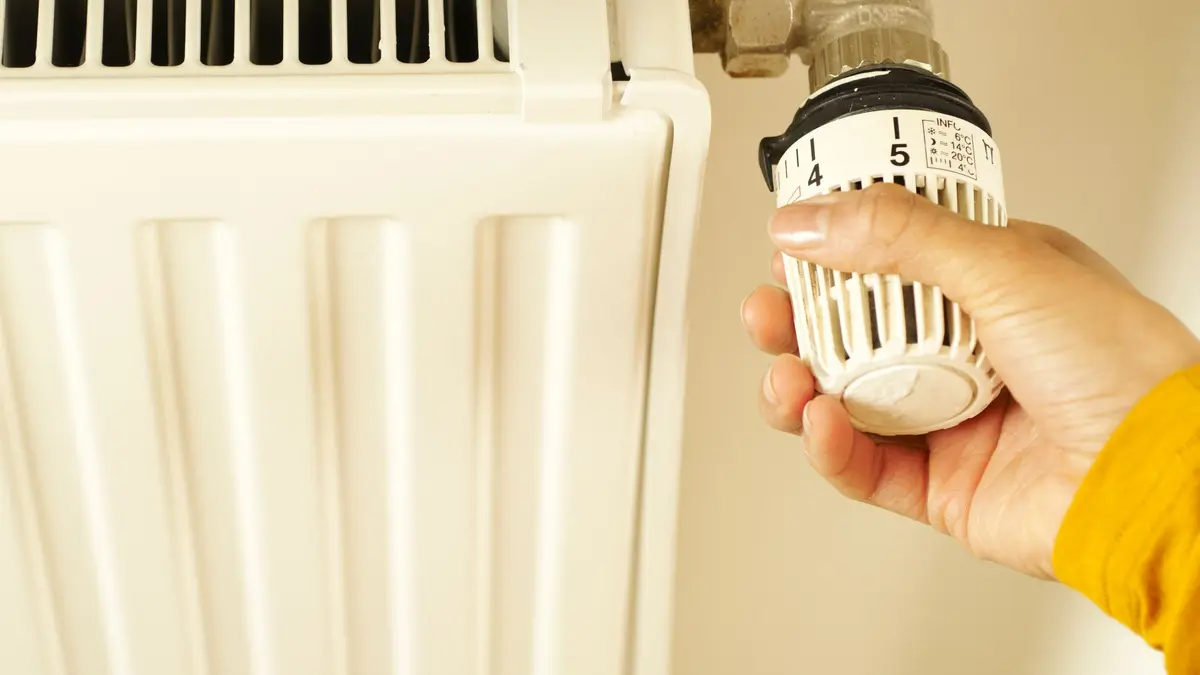
Bleeding radiators, then re-pressurising
Radiators that are cold at the top and warm at the bottom have air trapped in them. Bleeding lets that air out, and it is a routine job. The catch on a sealed system is that everything you release lowers the pressure, so bleeding and topping up always go together.
How to bleed a radiator safely
- Switch the heating off and wait until the radiators are cool. Hot water can scald.
- Hold a folded cloth under the bleed valve at the upper corner of the radiator.
- Fit a radiator key and turn it about a quarter turn anticlockwise. You should hear air hissing out.
- As soon as a steady trickle of water appears, close the valve again.
- Work around the house, starting downstairs and finishing upstairs.
When you have finished, go back to the boiler and read the gauge. It will almost certainly have dropped. Bring it back up to the cold figure through the filling loop, then run the heating and feel each radiator to make sure it heats evenly.
If the same radiator needs bleeding every week, gas is being produced inside the system, which is often a sign of internal corrosion. Black water from the bleed valve points the same way. Cleaning the system and adding fresh inhibitor usually settles it down. A radiator that stays cold after bleeding, or a valve that weeps or will not turn, may need a radiator repair rather than more bleeding.
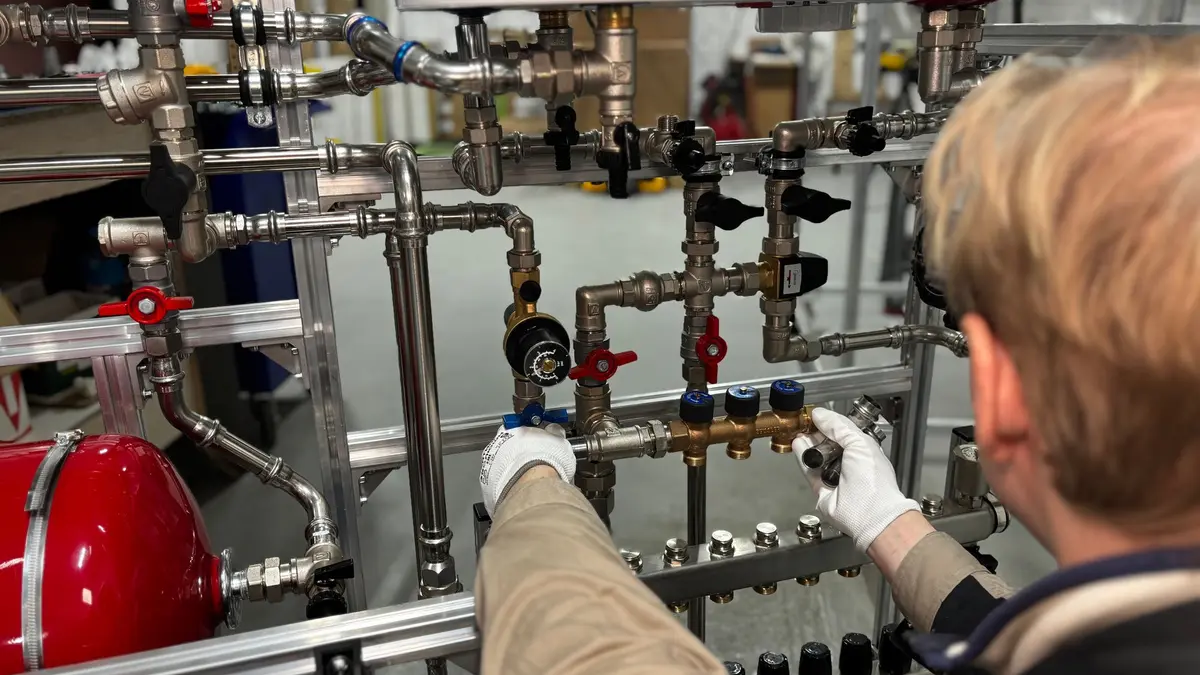
The expansion vessel and pressure spikes
Every sealed system has an expansion vessel, usually a red or grey cylinder either inside the boiler or mounted on nearby pipework. Inside is a rubber diaphragm with water on one side and a cushion of air or nitrogen on the other. When the water heats up and expands, it pushes into the vessel and squeezes that cushion, which keeps the pressure steady.
Over time the vessel slowly loses its charge, or the diaphragm splits. Once that happens the expanding water has nowhere to go, and you see a very particular pattern:
- The gauge reads normally when the system is cold.
- Within minutes of the heating starting, the needle shoots up towards 3 bar.
- The pressure relief valve opens to protect the boiler and dumps water outside.
- When the system cools, the pressure sits well below where it started.
- You top up, and the whole cycle repeats.
From the outside it looks like a leak, and in a sense it is, because water is lost through the relief valve every time the heating runs. Topping up more will not cure it and tends to make the next spike worse.
Checking and recharging a vessel means isolating and draining the boiler side of the system and testing the pre-charge with a gauge. On many combis the vessel sits inside the casing, so this is work for a Gas Safe registered engineer. If the diaphragm has failed, the vessel is replaced.
Looking for a leak you cannot see
If the pressure falls steadily and there is no spike when the heating runs, water is escaping somewhere on the circuit. Sealed systems hold a small volume, so a tiny weep can empty the pressure over a week without leaving an obvious puddle. A methodical walk around the house is worth doing.
- Under every radiator: run a dry tissue around each valve, the nut joining the valve to the radiator and the bleed valve. Brown staining or crusty deposits mark an old weep.
- Radiator bodies: pinholes along the lower seam show as rust spots or a damp patch on the carpet.
- Around the boiler: look at the pipes beneath it and the cupboard floor for drips or tide marks. Do not open the casing.
- Ceilings and walls: new brown stains, bubbling paint or a musty smell below a bathroom or airing cupboard can mean a pipe leaking under the floor.
- Ground floors: warm or damp patches can point to a leak on pipes buried in concrete.
- Towel rails and cylinders: check the connections in bathrooms and airing cupboards too.
Victorian and Edwardian houses in Beckenham often have heating pipes that have been extended and rerouted several times, with joints hidden under floorboards. If nothing is visible, professional leak detection uses thermal imaging and pressure testing to trace the leak without lifting half the floor.
Check the discharge pipe outside
On an outside wall near your boiler there is usually a short copper pipe that turns down towards the ground. This is the discharge pipe from the pressure relief valve, a safety device that opens if system pressure climbs too high, commonly around 3 bar. It lets water escape outside rather than allowing the pressure to keep building.
It is easy to overlook, so go out and look at it when you notice the pressure falling. Signs that it has been discharging include:
- A drip hanging from the end of the pipe, or a steady trickle.
- A wet patch, green algae or white limescale on the wall or ground below it.
- Fresh staining that appears after the heating has been on.
If the pipe drips mainly while the heating is running, the likely cause is the expansion vessel, or a filling loop that has been left slightly open and is overfilling the system. If it drips all the time, even when the system is cold and the pressure looks normal, the relief valve itself may be passing. These valves can fail to reseal after they have opened a few times, particularly if debris lodges in the seat.
Never cap, block or bend the discharge pipe to stop the drip. The valve protects the boiler and the people in the house, and it must always be free to discharge. Replacing a relief valve is a repair for an engineer, not a DIY job.
When to stop topping up and call an engineer
Topping up treats a symptom. Every litre of fresh mains water you add brings in oxygen and minerals that feed corrosion and scale, so repeated refilling slowly harms the system. It is time to book a boiler repair visit if any of these apply:
- You are topping up weekly or more often.
- The pressure spikes when hot and falls when cold.
- The discharge pipe outside is dripping.
- There is a damp patch or stain you cannot explain.
- The boiler keeps showing a low pressure fault code.
What the engineer will do
A Gas Safe registered engineer will start by asking how often you top up and what the gauge does hot and cold, so your notes help. They will check the expansion vessel pre-charge, test the relief valve and filling loop for passing, inspect the boiler's internal components for weeps, then work outwards along the system. Older systems with cast iron radiators or buried pipework may need a pressure drop test to prove whether the leak is on the pipework. Once the fault is fixed, the system is refilled, bled and dosed with inhibitor.
Any work inside the boiler must only be done by a Gas Safe registered engineer. If you ever smell gas, call the National Gas Emergency Service on 0800 111 999, open doors and windows, do not use electrical switches, and turn the gas off at the meter if it is safe to do so.